Hasbro Is Printing More Magic Up Front. The Next Miss Will Look Different.
Magic revenue grew 32% and passed $500 million in a quarter for the first time. Marvel Super Heroes also became the biggest day-one release in the history of the game.
By the time Hasbro started taking questions, those numbers had already swallowed most of the coverage.
The useful part came when management started talking about supply. Hasbro spent part of 2025 chasing demand after products were already on sale. This year it printed more up front, sent larger allocations into distribution and gave Marvel more launch inventory than Final Fantasy.
So Marvel’s record was partly a demand story. It was also a capacity story.
Hasbro has decided it would rather risk printing too much than miss another hot launch. Marvel absorbed that bet without leaving a visible pile of inventory behind.
The next ordinary Magic set may not.
Hasbro is choosing inventory risk
Asked about printing capacity, management said it spent part of 2025 chasing demand and “left some demand on the table” for certain releases.
Hasbro did not identify the products. But Final Fantasy is a reasonable guess because management later compared its launch allocation directly with Marvel’s, but the transcript never confirms it.
The firm claim is narrower. Hasbro believes it undersupplied part of the 2025 schedule.
Its response for 2026 was to put more product into the market before release. Initial print runs are larger. So are the first allocations sent into distribution.
Reprints still take longer than Hasbro wants, but larger opening runs reduce how much the company has to depend on them during the launch window. The goal is to have enough product available while demand is at its highest, instead of delivering more boxes after stores have already sold through.
Hasbro is also adding print capacity with its partners for 2027 and 2028. This goes beyond Marvel or one strong quarter.
There is a basic tradeoff here.
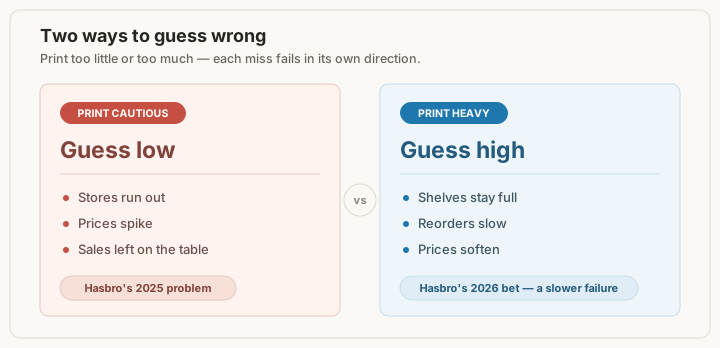
A cautious print run protects against unsold inventory. When the set overperforms, stores run out, prices jump and Hasbro loses sales while everyone waits for another wave.
A larger print run captures more of that early demand. It also puts more product into distributors and stores before Hasbro knows exactly how strong the release will be.
Hasbro spent 2025 dealing with the first problem. It is now taking on more of the second.
Marvel made that decision look easy.
The set received a larger initial allocation than Final Fantasy, yet Hasbro said inventory stayed at reasonable levels. Sell-through was brisk and channel partners continued ordering.
The extra product moved.
That helps explain how Marvel set the record. Demand was enormous, but Hasbro also gave stores enough inventory to convert more of that demand into sales. A product cannot break a launch record if nobody can restock it.
Marvel does not prove the same approach will work across the release calendar.
It was backed by one of the largest entertainment properties in the world, reached customers outside the usual Magic audience and received support from retailers that do not normally move much organized-play product.
The real pressure appears when Hasbro gives an ordinary set the same treatment.
If it guesses low, the old pattern returns. Stores sell out and prices rise while the company waits for more product.
If it guesses high, the launch may still look healthy. The boxes arrive. Shelves stay full. Then reorders slow, sellers start cutting prices and the next release lands before the previous one has cleared.
That is a quieter failure than a sellout. It also lasts longer.
The sealed market will show whether the bet worked
A larger opening allocation changes which signals matter.
Launch-week shortages become less useful when Hasbro is deliberately trying to prevent them. An early price spike may reflect a tight allocation rather than durable demand. Record first-day revenue also needs context when the company shipped more product than it did for the previous record holder.
The better evidence comes after the opening rush.
How much listed supply remains after 30 days? Does it continue falling, or begin building as more inventory reaches sellers? Are stores placing new orders because they sold through, or are they discounting boxes from the first shipment?
Price behavior matters too. A product that holds its price through several restocks is telling us something different from one that peaks during release weekend and weakens as soon as supply arrives.
Marvel and Final Fantasy give MTGSold a useful comparison.
Marvel began with more inventory. Final Fantasy launched under tighter supply and continued receiving reorders well after release. They reached the market under different conditions, which makes a simple comparison of day-one revenue nearly useless.
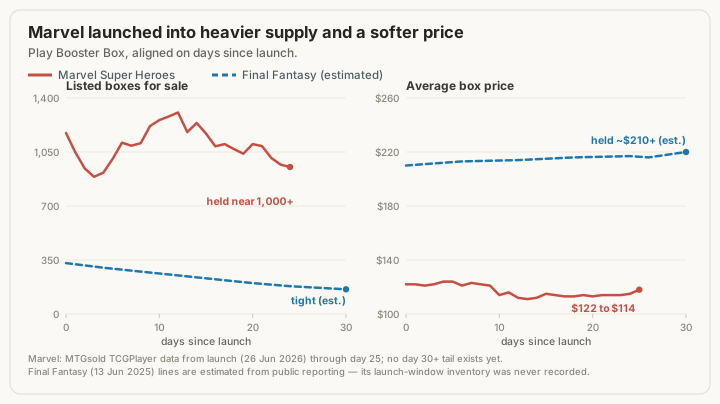
Our own data gives an early answer, and it does not fit the clean version.
Through Marvel’s first 25 days, its Play Booster Box supply never really came down. Listed boxes held between about 900 and 1,300, and the price drifted from around $122 to $114.
Final Fantasy launched the other way. Supply was tighter and the box price held near or above its $210 starting point.
So the early read leans against a pure demand story. Marvel’s price softened while its shelves stayed full. That is the slower kind of problem, not a sellout.
I would not lean on that yet. Marvel is 25 days old. There is no 30, 90 or 180 day comparison to make against Final Fantasy’s full year. Its follow-up products have barely started selling, and we never recorded Final Fantasy’s launch-week inventory ourselves, so its side of the chart is estimated from public reporting and Hasbro’s own note that the set kept getting reorders.
Marvel won opening day. That does not settle the lifetime comparison.
Set count is the wrong measure
Another answer during the call changed how I think about Magic’s release schedule.
Management said sets vary in SKU count, card count and complexity. Marvel was described as commercially comparable with Lord of the Rings and Final Fantasy. The Hobbit will still be a large set, but Hasbro expects it to be smaller because it has fewer cards and fewer products.
Those differences, according to management, track closely with sales potential.
Most discussions about release fatigue start by counting sets. Six releases sounds manageable. Seven sounds excessive. Each date on the calendar is treated as one equal unit.
The products are nowhere close to equal.
One set might include multiple booster configurations, four Commander decks, premium Bundles, serialized cards and several rounds of follow-up products. Another may have fewer cards and a much narrower lineup.
Both count as one release.
They do not create the same amount of inventory. They do not create the same revenue opportunity for Hasbro, and they do not ask the same amount of attention or money from players.
I think release mass gets closer to what people are trying to describe.
Set count tells us how many dates appear on the calendar. Release mass asks how much product is attached to those dates.
There probably is not one perfect formula for it. Card count would matter. So would the number of Commander decks, booster types, premium treatments, price points and later products connected to the set.
The point is not to manufacture a precise score. It is to stop pretending that a small release and a Marvel-sized release place the same weight on the market.
That distinction matters for 2027.
Hasbro currently plans six sets, divided between three Universes Beyond releases and three first-party Magic releases. It described 2026 as roughly seven sets, although the timing of one release makes the like-for-like comparison closer to six and a half.
Management also said first-party Magic should represent a larger share next year.
A simple count makes the schedule look flat to slightly lighter. That could be true. We do not know enough yet.
Six large releases can contain more cards, more products and more total spending opportunities than seven smaller releases. Hasbro can also increase first-party revenue without adding another Universes Beyond set if those first-party releases carry more product.
This matters outside an earnings model.
Players do not become exhausted because another date appeared on a calendar. They become exhausted by the cards they are expected to learn, the products they have to evaluate and the amount of money required to keep up.
If the number of releases falls while the amount attached to each one grows, the pressure has not necessarily eased.
Marvel buyers still have to come back
Hasbro said the Magic player base is growing. New players are entering, lapsed players are returning and established players remain engaged.
Distribution is also expanding at a double-digit rate, roughly in line with revenue. Hasbro added Wizards Play Network accounts while growing its presence in mass retail.
The call did not show how much of the quarter came from each source.
Marvel offers a clearer view of the distribution side. Management said it performed especially well with new customers and in places that do not traditionally sell much organized-play Magic.
Disney theme parks and GameStop were the examples.
A pack sold at a Disney park counts the same as a pack sold at a local game store when Hasbro reports revenue. The buyers may behave very differently afterward.
For one customer, Marvel may be the first step into Magic. For another, it is a Spider-Man souvenir that happens to contain trading cards.
Both are successful sales. Only one is likely to create demand for the next first-party set.
The follow-through comes in two stages.
The Hobbit will test whether customers acquired through Marvel will follow Hasbro into another licensed property. That would show cross-IP retention. They came for one franchise and stayed for another.
A first-party Magic release is the tougher test. Buying that product would mean the customer stayed after the familiar licensed characters were gone.
That is when a Marvel customer begins to look like a Magic customer.
Someone who buys only Marvel cards is still valuable to Hasbro. The company reached a person who may never have bought Magic otherwise.
But that sale alone does not prove the core player base became deeper.
Hasbro did not provide retention figures, spending by customer type or a breakdown between growth from new stores and growth inside existing accounts. It says the player base is expanding, and that may be correct. The quarter does not tell us how much of that growth will remain after Marvel.
A few numbers need context
Hasbro expects Magic revenue to decline by a low-single-digit percentage in the fourth quarter. Management also said roughly $40 million of that change comes from moving an early-year set by a few weeks.
Lorwyn launched in late January 2026, allowing some of its revenue to land in the previous quarter. The comparable 2027 release is scheduled for February, which moves those sales into Q1.
Demand does not have to change for the quarterly comparison to move by $40 million.
That makes individual Magic quarters less clean than they appear. A weak quarter can contain healthy demand if the release calendar moved against it. A strong quarter can benefit from having an extra launch inside the reporting period.
The dates need to be normalized before the growth rate says much about the underlying market.
The call also included a distribution breakdown of roughly 70% hobby, 20% mass and 10% international.
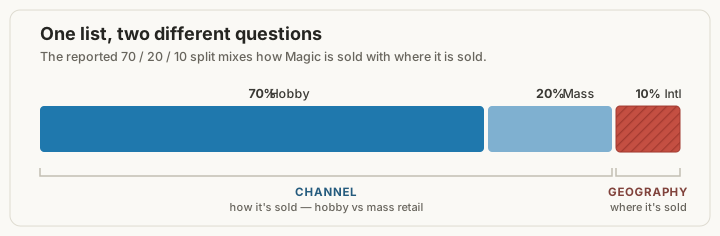
I would be cautious with that split.
Hobby and mass are channels. International is a geography. An international sale can also take place through a hobby store or mass retailer, so the three categories do not appear to be mutually exclusive in the same way.
The broad shape is still useful. Hobby remains the largest part of Magic distribution, while mass retail and international sales are growing.
The precise three-way breakdown needs a better definition before it should be treated as a clean segmentation of the business.
What comes next
The $500 million figure is accurate. It just tells us less than the details buried later in the call.
Hasbro has increased initial supply because shortages cost it sales in 2025. Marvel absorbed the additional inventory, but Marvel was about as favorable a test as Hasbro could have chosen.
The next ordinary release will be more revealing.
If larger opening runs continue selling through without damaging prices, Hasbro may have found a better balance between scarcity and availability.
If inventory begins sticking around, the company will have traded one visible problem for a slower one.
The same applies to Marvel’s new customers. Their first purchase produced the record. Their second purchase will tell us whether they followed Marvel, Universes Beyond or Magic itself.
The record is already on the books. The next few releases will tell us what kind of record it was.