Magic Just Had Its First $600 Million Quarter. Hasbro Says the Next One Will Shrink.
Magic made $616.1 million in Hasbro’s third quarter, the first time the game has passed $600 million in three months. Chris Cocks spent part of the first answer on the call explaining why the fourth quarter will be smaller.
Stephen Laszczyk of Goldman Sachs had asked what outperformed. “Everything,” Cocks said, and then, without being asked, added that fourth-quarter Magic “will likely be down,” by low to mid single digits.
James Hardiman of Citi followed up by laying out the moving pieces and telling management that “one of the big questions we’re getting is a fourth quarter that was worse than sort of where the street was thinking about it.” Cocks answered, “You totally captured it,” and then gave the line I’d put at the top of any summary of this call:
We manage the game for the fans and not for quarterly results. That should be an expectation moving forward.
Management added that it had been “staring at the same math ourselves” while preparing and knew it would be one of the top questions. So the answer was prepared, and what Cocks prepared was a new way of describing the business. Hasbro now treats when it ships Magic as a decision it makes for its own reasons, and it told Wall Street to stop reading the quarterly swings as demand.
My read is that the same logic applies to the record. Hasbro loaded the channel this quarter, and the call says so in pieces if you put them next to each other.
“The channel wanted it”
About $40 million of the third quarter had been expected in the fourth. Gina Goetter, Hasbro’s finance chief, said so in the prepared remarks, named Reality Fracture as most of it, and called the shift “business as usual.”
Cocks gave the reason while answering Laszczyk. The supply chain “was able to deliver a bit earlier and the channel wanted it.”
Gerrick Johnson of Seaport asked the mechanical version later: how long is the lag between Hasbro recognizing revenue and a hobby shop making the sale? The answer was that “the vast, vast, vast majority” of Magic goes through distributors, six to eight majors in the US and three or four in Europe, and that “our distributors will take products anywhere from on the low side two weeks, on the high side six weeks before a major release.”
Reality Fracture released October 2. Hasbro’s quarter ended September 27. Inside a two-to-six-week window, the same pallets can count in either quarter depending on when the trucks leave, which is why Goetter told Hardiman that “one week can make a difference, a meaningful difference in the quarter.”
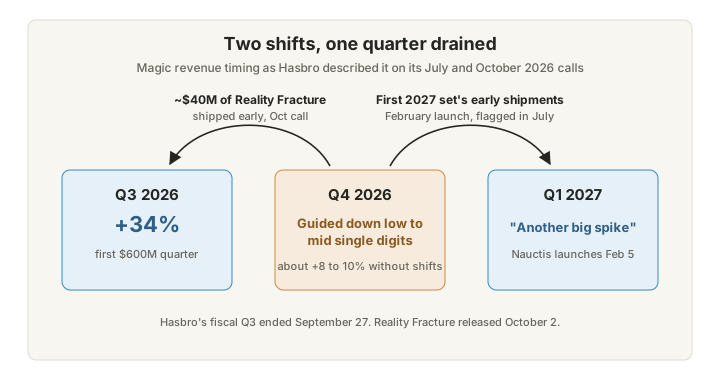
There’s a second shift going the other way. In July, Hasbro said the first 2027 set, Nauctis: The Sunken Realm, would launch in February, later than this year’s January release, so its early shipments move out of the fourth quarter and into the first. Cocks said that without both shifts, fourth-quarter Magic would have been “up around 8 to 10 percent.” Instead, Cocks described the shape investors should expect: “a big growth like you had of 30 percent plus in Q3,” then “a modest kind of decline in Q4,” then “another big spike in Q1.”
This is the third quarter in a row with a timing note attached. In May I wrote that the first-quarter beat borrowed from the second. In July it was the February launch. Now it’s Reality Fracture. On this call, Cocks made the pattern policy, in the same answer to Hardiman:
We’re chasing demand. We’re going to be opportunistic about when we supply… You can count on the fact that that’s not a demand signal. That’s just the timing of when we ship.
Hasbro loaded the channel
I agree with Cocks about the down quarters. A dip caused by early shipping doesn’t say much about demand. A record caused partly by early shipping doesn’t either, and the headlines after the call led with the record.
The call itself has the numbers that separate the two. Magic revenue, which is what Hasbro sold to distributors, grew 34% from a year ago. When Johnson asked about retail sales, Hasbro said point-of-sale for trading cards at the retailers it tracks was up “high single digits, low double digits,” with final September data still coming in. The answer didn’t say what period that compares against, and tracked retail leans toward mass merchants while most Magic sells through hobby stores. Even with those caveats, the gap between 34% and high single digits is wide.
Revenue: Hasbro's Q3 2026 earnings release, $616.1 million against $459.4 million. POS: Hasbro's answer to Gerrick Johnson (Seaport) on the October 20 call. Hasbro didn't say what period the POS figure compares against, and the retailers it tracks lean toward mass merchants, while most Magic sells through hobby stores.
The guidance points the same way. In July, Hasbro expected Wizards to grow low single digits in the second half. Goetter now says high single to low double digits. More product left Hasbro than it planned three months ago.
Part of that product went into new doors. Arpiné Kocharyan of UBS asked about distribution and was told that Wizards Play Network stores have grown about 38% since 2024, to more than 13,000, and that mass-retail doors are up about 28%, with Magic now in “close to 40,000 doors.” Every new store needs opening inventory before it sells a pack. That’s real growth for Hasbro, and it shows up as revenue before it shows up as players.
Goetter’s prepared remarks said Hasbro is producing more “than at any point in the brand’s history, and sell through is confirming the demand is there to support it.” Nobody on the call asked how much Magic is sitting with distributors and stores right now. Johnson came closest with the revenue-lag question and got an answer about timing. The one line about inventory being “clean” came in the toy section, about the holiday build.
TCGPlayer is one marketplace, so I’d only offer it as a picture of what this looks like on a shelf. On September 21, 16 sellers listed the Reality Fracture Play Booster Display there. By October 19 there were 92, and the two-week average sale price had fallen 12%. Hasbro shipped the set early because the channel asked for it, and some of the channel is now trying to sell it.
Retention, measured in reprints
Xian Siew of BNP Paribas asked about repeat players, the people who come in through a Universes Beyond set and stay. Cocks said “the best proxy for that is backlist sales,” and that “back list is actually growing faster” than new releases. Cocks described a Magic player as active for five to seven years, sometimes stepping away “for maybe a year or two because they have a life stage,” then coming back, and said Hasbro measures retention “in years and generations.”
Goetter added that backlist sales in 2026 had already passed all of 2025, and named the biggest backlist sellers last quarter “in terms of distribution”: Foundations, Final Fantasy, and The Lord of the Rings.
Backlist sales also rise when Hasbro reprints. If another wave of an older set ships to distributors, backlist revenue goes up whether or not a single new player stayed. Eric Handler of Roth asked for the split between new releases, backlist, and Secret Lair. Goetter said most revenue comes from new releases, and on the split itself:
We typically don’t provide those levels of splits.
I don’t think Hasbro is inventing its retention story. The five-to-seven-year lifecycle sounds right to anyone who has quit Magic and come back. My problem is that the number offered as proof goes up every time Hasbro ships a reprint, and Hasbro is shipping more of everything.
The 50% number
Answering Laszczyk, Cocks said Hasbro would normally expect a lean release like The Hobbit to sell about 50% less than a full one. The Hobbit, Cocks said, “is going to do about and maybe even more lifetime than Lord of the Rings will do,” with far fewer products. The set is two months old, so “lifetime” is a projection, but the claim is that the smaller lineup didn’t cost Hasbro much.
Answering Anthony Bonadio of Wells Fargo about 2027, Cocks said all six major sets “will be full sets. They’ll have all the commander decks and all the collectible products,” and that Hasbro sees “upwards of a 50% or even greater difference in sales per set when you have that full product suite.” Then Cocks told the analysts directly: “That’s something I think you need to factor in.”
What Hasbro would normally expect a lean release to sell, against a full one.
"Upwards of a 50% or even greater difference in sales per set" when every Commander deck and collector product is attached.
Both figures from Chris Cocks: The Hobbit in the answer to Stephen Laszczyk (Goldman Sachs), 2027 in the answer to Anthony Bonadio (Wells Fargo). The Hobbit released in August, so "lifetime" is a projection.
In July I called this release mass, the amount of product attached to each date on the calendar. Next year has fewer dates and more product on every one of them. Hasbro guides 2027 Magic growth to mid to high single digits, and the full lineups look like the main way it gets there. The Hobbit is Hasbro’s own evidence that a lighter set can work, and the 2027 plan goes the other way.
Margins come down on a schedule
Hardiman’s second question was about Wizards’ operating margin, which is close to 50% this year. Goetter guided 2027 to the high 30s. Most of the drop is amortization for the Exodus video game, which launches April 7: about 65% of that cost lands in the first three months, so the second quarter of 2027 takes the hit. Royalties will be “a little bit heavier” with the Universes Beyond schedule.
In February I wrote that the low 40s was the right long-run model for Wizards, not 46%. Hasbro printed 49.2% this quarter and then guided next year below my number.
After the record
Cocks finished the answer to Hardiman by saying who the ship dates are picked for: “the best possible time for our channel partners and for our fans.” The next date on the schedule is Star Trek, on November 13. Two to six weeks before November 13 is October 2 through October 30, so by Hasbro’s own shipping window, Star Trek’s launch shipments all land inside the fourth quarter.